
San Dimas City Directory Collections by Era
The strongest verified San Dimas city directory catalog is held by the San Dimas Historical Society. It records a nonannual local run, telephone volumes, regional Pomona products, a newspaper-publisher guide, a reverse directory, and later civic and business works. The table keeps the access path visible because a catalog entry does not mean an interior scan is online.
| Collection | Years | Where Held | Access |
|---|---|---|---|
| San Dimas Directory / City Directory | 1905, 1907, 1909, 1911, 1912-13, 1914, 1916-17, 1919-20, 1922-23, 1924, 1926 | Historical Society catalog | Contact Walker House; handling and copy fees not posted |
| Home Telephone Directory of San Dimas | 1904, 1909, 1926-27, 1928 | Historical Society | In-person or inquiry; subscriber scope |
| Associated Telephone Co. volumes | 1932, 1936, 1938, 1939, 1941, 1942, 1946 | Historical Society catalog | Catalog reference; interior access to verify |
| San Dimas Press Directory and Information Guide | 1954 | Historical Society and local-history leads | Ask the Society or library reference desk |
| Luskey’s Criss Cross City Directory | 1959 | Historical Society / library inquiry | Address-first reverse section |
| Pomona-area directories and NARA microfilm | 1895-98, 1931, 1934 | Society and regional repositories | Verify San Dimas pages in each volume |
Gaps are part of the record. San Dimas volumes do not run every year, and the research did not verify a definitive last printed residential directory. Telephone books are subscriber lists, not population counts. Regional Pomona volumes matter because San Dimas was not incorporated until 1960.
The Historical Society catalog is the source shown in the collection image below and the best place to confirm a listed year.
The catalog does not by itself mean that every interior page is digitized.
Note: A cataloged cover proves a listed volume, not that its resident pages are digitized or open on demand.
San Dimas Directories Began Before Incorporation
A San Dimas city directory entry can predate the city government. San Dimas incorporated August 4, 1960. Earlier residents may be indexed under Mud Springs, Pomona, Pomona Valley, Los Angeles County, Rancho San José, or an unincorporated San Dimas label. The townsite and street layout followed the railroad boom and San Jose Ranch Company lots in 1887, so a 1904 directory is already a later layer in a longer place history.
Use the place name printed in the volume, not a present-day assumption. A directory’s geographic scope may cover nearby communities, and the same street can appear with a different municipality line. The 1890 census loss makes city directories, newspapers, deeds, and local clippings more important for the years around that gap.
| 1837 | Rancho grant context for early land descriptions. |
|---|---|
| 1887 | Santa Fe arrival and San Jose Ranch Company town-lot layout. |
| 1904 | Verified start of the specific San Dimas directory sequence. |
| 1960 | San Dimas incorporation, changing the indexing context. |
San Dimas Telephone Directories
Home Telephone and Associated Telephone volumes extend the San Dimas city directory trail through 1946, but a telephone book describes subscribers. A person without a listed line, a household using another name, and a business number can all produce a misleading absence or address. Read the publisher and coverage line before treating a page as a resident source.
Pomona Directory material from 1895-96, advertising copy from 1897-98, Doyle’s Valley Directory in 1914-15, Pomona Valley Telephone and Telegraph Union in 1930, and NARA microfilm volumes for 1931 and 1934 widen the search. The regional layer is especially useful for pre-1960 research when “San Dimas” is not the official place label.
The 1904-1919 catalog series is the source shown in the first series image below.
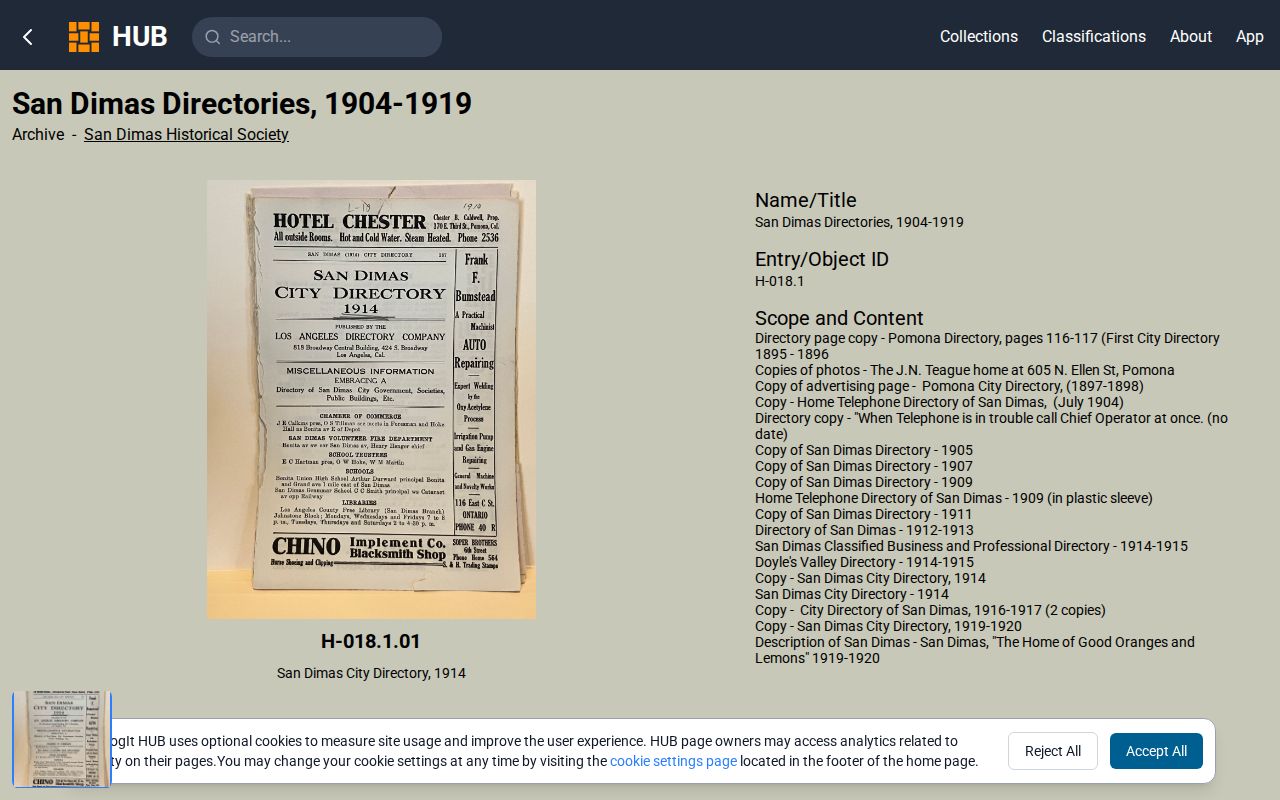
That series anchors the local sequence, while regional volumes fill years the Society does not list.
The 1920s catalog series supplies the source for the next decade’s image and keeps a search tied to the correct volume.
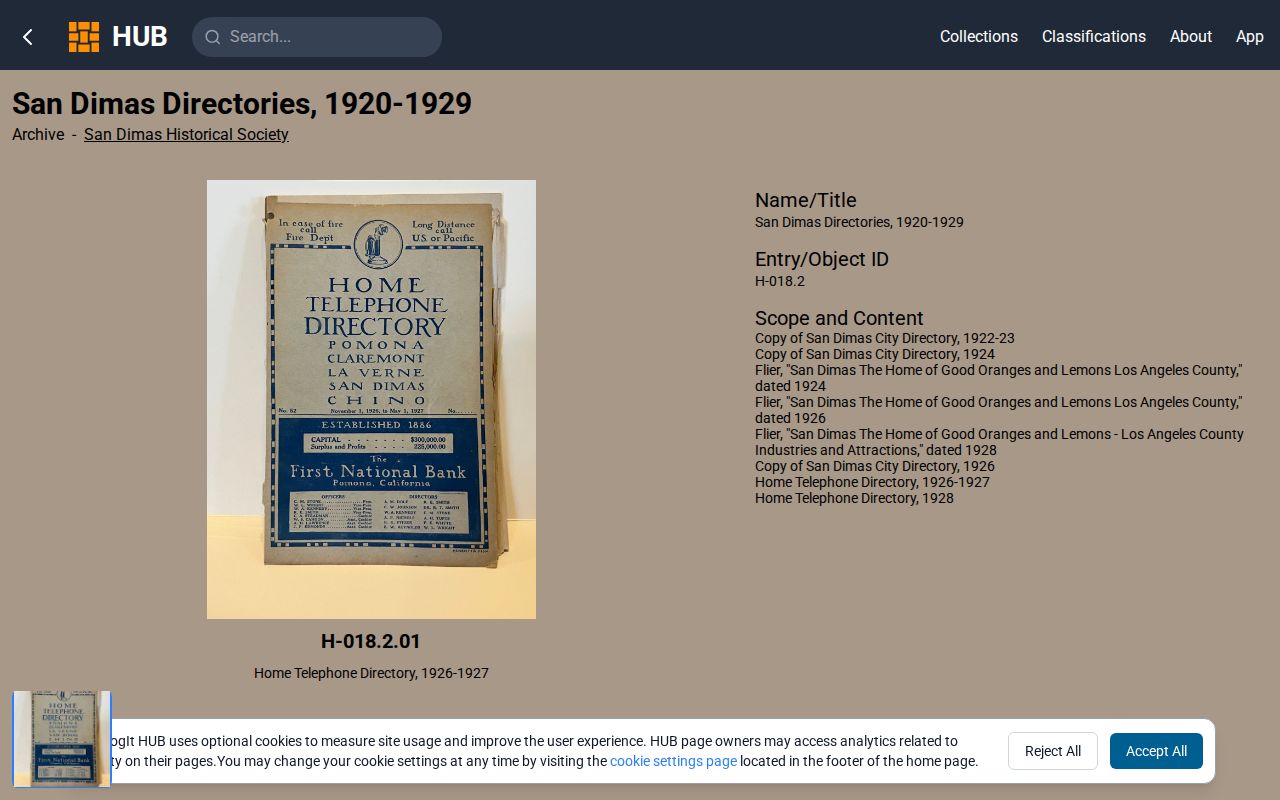
The nonannual run should be checked year by year rather than assumed from a general catalog page.
Note: Place labels in older volumes can matter as much as the surname when the city did not yet exist.
Walker House San Dimas Directories
The Historical Society works from Walker House, second floor, 121 N. San Dimas Avenue. The Society lists a P.O. Box 871 mailing address, phone 909-592-1190, and Office91773@sandimashistorical.org. The public catalog does not state appointment, handling, copying, or research-service fees, so contact ahead. Catalog descriptions and selected cover images are not proof that every interior page has been digitized.
The Society’s broader material connects directory names to citrus associations, packing houses, railroad and water-company history, schools, churches, service clubs, Chamber records, and business ephemera. Those collections can explain why a person appears in a particular San Dimas city directory and can supply a second source for a family-history trail. They show affiliation, not a current address.
The San Dimas Historical Society is the source represented in the Society image below and the contact route for interior-page inspection.
Contact ahead because appointment, handling, and copying fees are not posted in the public catalog.
San Dimas Library Directories
San Dimas Library began in 1913 behind Fairbank’s Drug Store and currently posts a renovation closure. Its public services include research help, catalog and databases, Email a Librarian, and LA Times access. The broader LA County Library Californiana collection in Norwalk has more than 24,000 books, over 200 newspaper and magazine titles, California census schedules from 1850-1910, historic newspapers, nineteenth-century directories, and city and county histories.
Closed-stack access means a reader may need a catalog request or reference question rather than an open shelf visit. Ask specifically for San Dimas, Pomona Valley, reverse, criss-cross, telephone, census, newspaper, and obituary material. The research did not verify a branch shelf list for San Dimas yearbooks, an obituary index, or every reverse-directory run.
The San Dimas Library page is the source represented in the library-service image below.
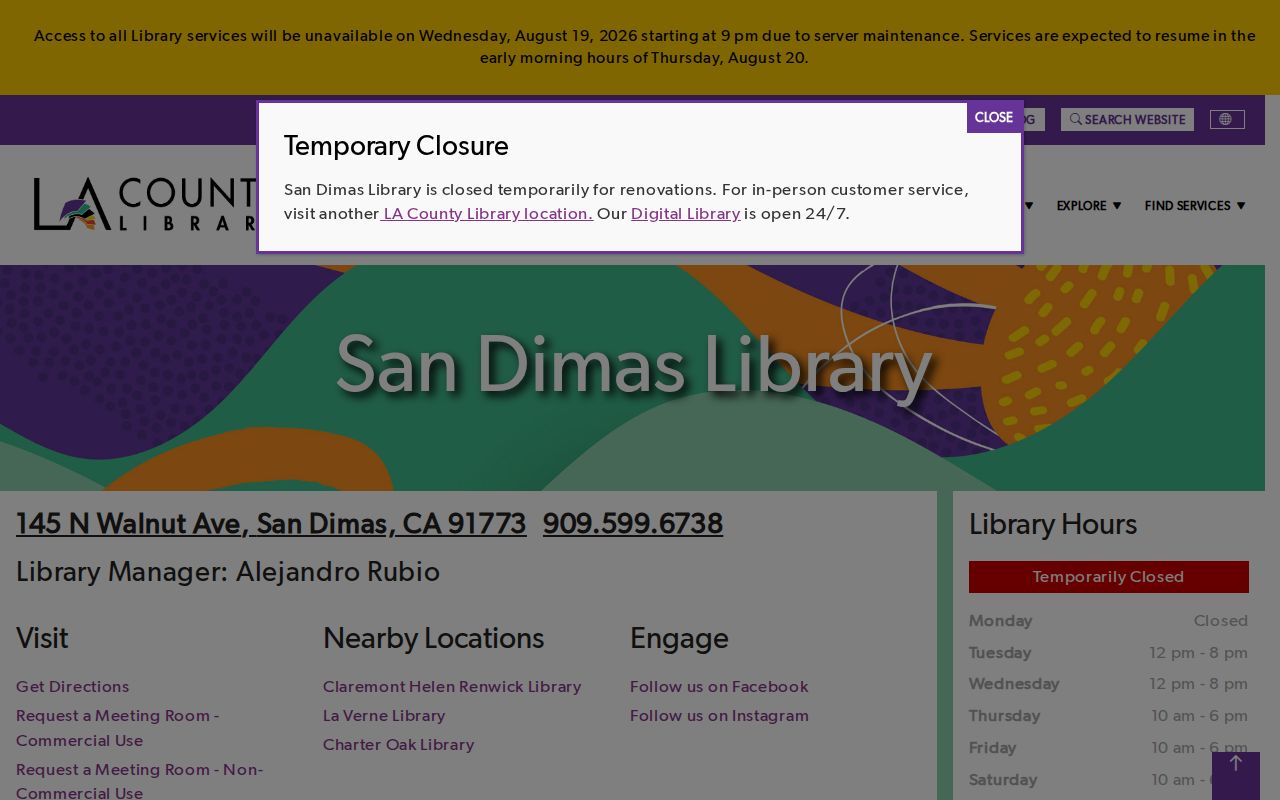
The current reference route should be checked before a directory search.
Note: Closed stacks make a reference request part of the search, not an indication that the collection is missing.
Read a San Dimas City Directory Entry
Interior pages from the 1914 and 1930 catalog inspections were not available, so no spouse, occupation, owner mark, or abbreviation is claimed as a verified San Dimas example. Before citing an entry, inspect the page and photograph or transcribe its key. A name line can be a clue, but its meaning comes from the volume’s scope and symbols.
| Surname and given name | Transcribe initials, spelling, hyphens, and order exactly. |
|---|---|
| Spouse or widow notation | Record only when the printed entry and key support it. |
| Occupation or affiliation | Useful for identity, but not a residence guarantee. |
| Residence | House number, street, exchange, or a boarder abbreviation. |
| Owner or rental mark | Use the volume’s symbol key; never assume the mark. |
| Removal or death note | A lead for newspapers, probate, or an obituary source. |
- Criss-cross directory
- A reverse volume arranged by street and number so an address can lead to a listed name.
- Householder index
- A name or address list centered on the person treated as the household head by that publication.
- Abbreviation key
- The publisher’s guide to short marks for residence, boarding, ownership, telephone, or other fields.
Do not read absence as departure. Nonsubscription, an incomplete volume, spelling variation, regional scope, and a move can look alike.
Luskey’s San Dimas Directory
Most city directories begin with a surname and end with an address. Luskey’s 1959 Criss Cross City Directory and Classified Blue Book is valuable because it reverses that path. Start with a street and number in the street section, write down the listed name, then check the alphabetical section for a second address or category clue. The result is a listed householder or subscriber lead, not a complete account of everyone at the parcel.
This is the historical counterpart to a modern map browse. A current address search supplies an AIN and parcel facts; the criss-cross volume can supply a past listed name. Use the legal description, census, deed, newspaper, or permit record to establish whether the two entries refer to the same place.
San Dimas Directory Clippings
Historical Society clipping catalogs cover 1927-37, 1950-89, and 1990 forward. They point to named residents, obituaries, schools, churches, clubs, veterans, and businesses with page references. A folder marked “obit” can lead to a newspaper page when no searchable obituary portal exists. It remains a finding aid, not a certified death record and not a complete newspaper archive.
Pair a clipping with the source newspaper, date, and page when possible. Relevant titles include the San Dimas Eagle, San Dimas Press, Highlander variants, San Gabriel Valley Tribune, Progress-Bulletin, and LA Times access through library resources. An obituary or school mention is strongest when its name, address, relative, or date matches another record.
Note: A clipping index points to a page; the newspaper or certificate supplies the source detail.
Trace San Dimas Directory Households
Use a nearest-known year, transcribe the directory entry, and move through the nonannual run rather than expecting an annual list. Pair each directory with the open federal census years from 1900 through 1950. NARA releases census material after 72 years, making 1950 the newest open census in the research period. The 1890 loss is why directories and newspapers carry extra weight.
- Start with a known person, address, or year and record every spelling variant.
- Search the San Dimas or Pomona Valley directory nearest that date.
- Follow the name forward and note each address, subscriber, spouse, or affiliation mark the page actually prints.
- Use the criss-cross section when an address is known but the surname is not.
- Pair the result with a census, deed, clipping, probate file, or later license record.
Because San Dimas incorporated in 1960, pre-1960 enumeration may use county, township, or Pomona geography. A missing name can mean a move, death, nonsubscription, spelling difference, or incomplete scope. The conclusion should follow the combined evidence, not one directory line.
Note: A directory year is a snapshot of a publication’s listed people, not a census of all San Dimas households.