
Find San Dimas Residents
Start a San Dimas residents directory search with the right record, because a broad name list rarely answers anything. An address points to the Assessor Portal first. If ownership matters, the Registrar-Recorder/County Clerk deed index comes next. California voters can check their own registration through the state's status form. A court party search shows that a case exists. A vital record answers only through its eligibility rules. For family history, the San Dimas Historical Society and LA County Library hold material that never became a current online directory.
These records do not describe the same thing. An owner can differ from a parcel's occupants. A voter file verifies one voter, not a street. A city directory names a listed householder or subscriber, not a whole household. Treat every result as dated evidence, and weigh it against a second independent record before concluding anything.
- Write down the exact name or normalized address, including spelling variants and the likely date.
- Use the Assessor address search to obtain the ten-digit AIN and parcel facts.
- Request a specific owner when the question is about title, then follow the deed index at Norwalk.
- Use court, vital, license, business, or historical sources only for the fact each record can confirm.
- Send a focused request to the custodian when no public search box covers the record.
When the target narrows to one street or one old address, the address-by-address route lives in the San Dimas street directory lookup. A single name works differently. That question needs its own checks.
San Dimas Records Offices
San Dimas is incorporated, in eastern Los Angeles County. Even so, its records trail runs region-wide. City Hall keeps the local slice: requests, permits, zoning, council material, business licenses, and an Online Records Library. The assessor supplies parcel and AIN facts. The Registrar-Recorder/County Clerk holds deeds, marriages, and fictitious business names, while Los Angeles Superior Court keeps civil, family, probate, small-claims, and criminal files. California agencies run the vital, voter, license, privacy, and custody systems.
Los Angeles County RR/CC
Real Estate Records and County Clerk
Norwalk headquarters and remote orders
(800) 201-8999 for birth records
Los Angeles County Assessor
AIN, situs, parcel maps, values
Owner facts by specific-property channel
213-974-2111 or 888-807-2111
California Elections
Private registration verification
Purpose-limited voter-file requests
Los Angeles County: 800-815-2666 option 2
Every records question has a keeper. City Clerk Debra Black is the local contact at City Hall, 245 E. Bonita Ave. The city's public-records page lists the request portal plus its email and counter routes. Each office answers a different slice of the San Dimas residents directory. The keeper matters as much as the search term.
San Dimas AIN from an Address
An address makes the cleanest starting point. The Los Angeles County Assessor Portal offers Basic Search, Legal Search, and Map Search modes. Its main control is one combined box labeled Search by AIN or Address. Type a street address. Back comes the ten-digit AIN, situs address, parcel polygon, map and legal references, effective date, assessment facts, and property characteristics. The portal is free, and it moves you cleanly from a door number to a stable parcel key.
AIN stands for assessor identification number. The local format uses four digits for the map book, three for the page, and three for the parcel, written NNNN-NNN-NNN. The tax bill or deed may also show it. Some addresses match more than one parcel. The county AIN guidance covers both that and lagging new-development parcels.
| Basic Search | General property-search mode. |
|---|---|
| Legal Search | Route for legal-description research. |
| Map Search | Browse parcel polygons and nearby sites. |
| Search by AIN or Address | Required for a direct lookup; an AIN has ten digits. |
| Parcel map | Clickable map evidence, not a title or survey. |
Three labels need separating. Situs is the physical parcel, while a mailing address is simply where a bill goes. The legal description is the title continuity key. Even the USPS delivery line can differ from all three.
Assessor results map the land. The owner name stays off the public web portal, a deliberate county choice. That split defines the San Dimas residents directory.
The California bizfile search adds a separate entity and address trail when the clue is an organization rather than a parcel.
An entity address can separate two similar names. It is not proof of where a person lives.
Note: An AIN identifies land, while a person search still needs a dated custodian record and a reason to compare names.
San Dimas Owner Records Offline
Los Angeles County treats its public Assessor website as a parcel-facts tool. Owner names and mailing addresses stay suppressed online. One reason: officials cannot flag every protected person inside a public record. One identified property can still yield its owner. Ask through the Assessor's Specific Property contact channel, by phone, or at a counter. Bring the full address or AIN. A map alone proves nothing about who lives there.
The same gap weakens commercial people-finder results. A finder can merge old addresses, owners, businesses, and strangers into one profile. Official sources give provenance and a date, but each serves a narrow purpose. A tax history shows a parcel obligation, not occupancy. The County Treasurer and Tax Collector may display up to three years of payment history, unless a return, refund, or correction suppresses it.
Local search tip. Write the AIN before requesting an owner. It gives the office one parcel to answer and keeps a common surname from becoming a false match.
The San Dimas NextRequest portal is the source represented in the request-center image below.
With no online index available, the San Dimas City Clerk can still trace a parcel. A focused address and date range helps that office locate the records you need.
San Dimas Deed Records at Norwalk
Los Angeles County real-estate records reach back to 1850. The grantor and grantee index, though, is not an internet search. The public workflow lives at the Registrar-Recorder/County Clerk headquarters, 12400 Imperial Highway, Norwalk. It runs in person. Start in the alphabetical name index, searching by surname and recording year. Note the document number once you land on an entry. You can also use the older book and page reference. From there, request the record image or an identified copy at the counter. Recorder staff will pull records all day. They do not perform title research for a street address. That boundary matters. Identified copies can be ordered three ways. Options are online through the county-linked vendor, by mail, or at the office itself. The county describes online orders as taking up to 20 working days from receipt. Charges shift with the document, the page count, and whether certification is needed. Rely on the current fee schedule rather than assuming one flat deed price. The Recorder's own viewing instructions make the logic plain. Match the address to an AIN first, and the rest of the search falls into place.
| Index key | What to record | Why it matters |
|---|---|---|
| Grantor or grantee | Party name and role | Moves the search one transfer backward or forward. |
| Recording year | Year or narrow date range | Reduces same-name results. |
| Document number | Retrieval identifier | Best key for a copy request. |
| Book and page | Older reference | Helps with records before modern numbering. |
A deed names an ownership instrument. It does not list every occupant. So a deed chain proves who held title, not who slept in the bedrooms. The chain is strongest when the legal description, the vesting language, and the recording date line up. The predecessor's name must fit the same clean sequence. The county's Recorder viewing instructions walk through the index steps the deed-record process depends on.
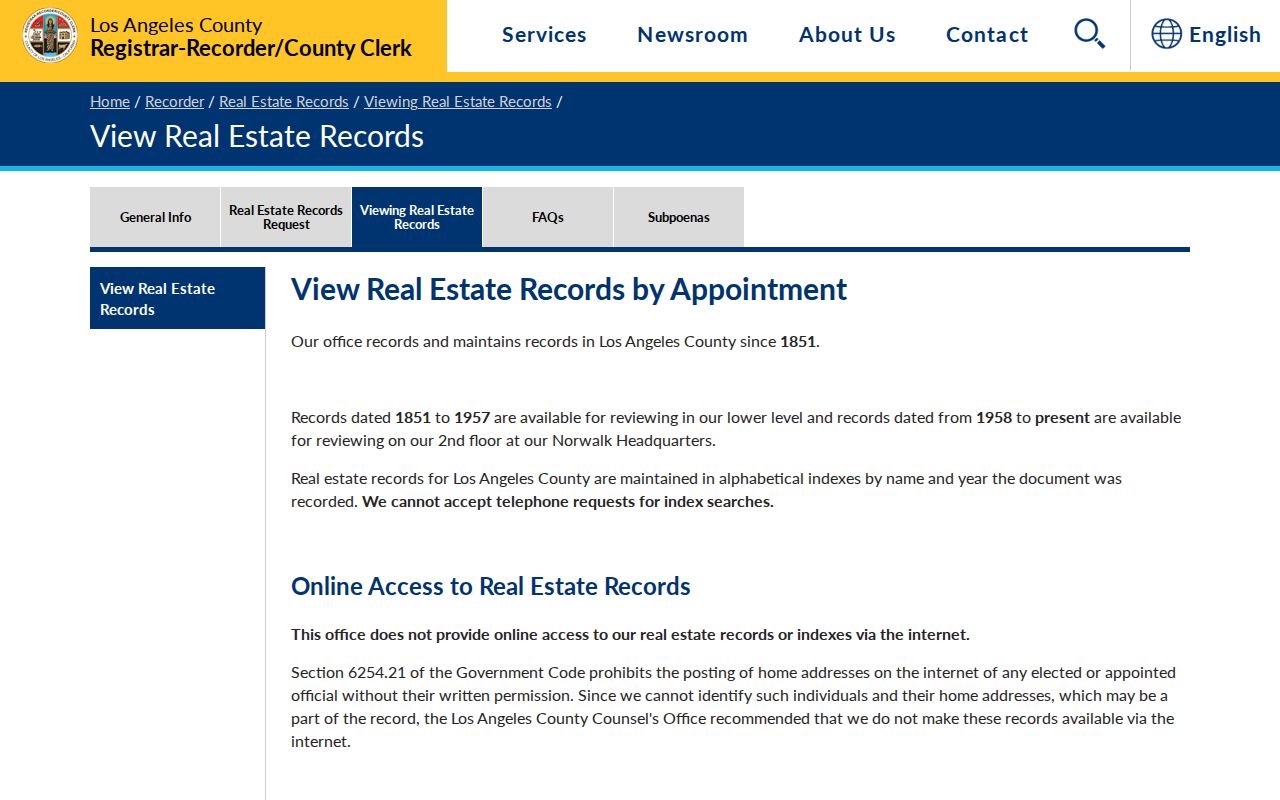
The Recorder's real-estate records page spells out the office-only index and the remote-copy fallback in plain terms. Note: The county's coverage back to 1850 does not make every deed image searchable from the public web.
San Dimas Resident Sources
A current San Dimas residents directory is really a set of partial rolls. Each roll has its own keeper. Each one has its own access rule too. The assessor's parcel data plus the deed trail stand strongest for recorded ownership. The voter tool works best for a person checking their own registration. Courts, vital records, business filings, and licenses can confirm a dated event or an affiliation. None of them, alone or together, amounts to a complete household list.
| Source | What it can show | Keeper | Access |
|---|---|---|---|
| Assessor parcel roll | AIN, situs, map, values, characteristics | Los Angeles County Assessor | Free address/AIN search; owner by request |
| Recorded deed index | Parties, instruments, dates, legal descriptions | LA County RR/CC | Norwalk terminal; identified copies by mail or online order |
| Voter status | One requester’s registration status | California Secretary of State | Private fields; file requests require a statutory purpose |
| Court case access | Party, case type, filing date, number, images count | Los Angeles Superior Court | Guest or registered search; fees and exclusions apply |
| Business and license records | Entity, license, agent, premises, status | California and San Dimas agencies | Mostly free public searches |
The useful question is never "which source lists everyone?" It is "which custodian can confirm this fact?" A record carrying a number, a date, a legal description, or an event county beats a vague name match every time, because it can be re-checked at the source. That habit keeps a resident lookup honest. The California My Voter Status form is the official tool behind any voter-status verification.
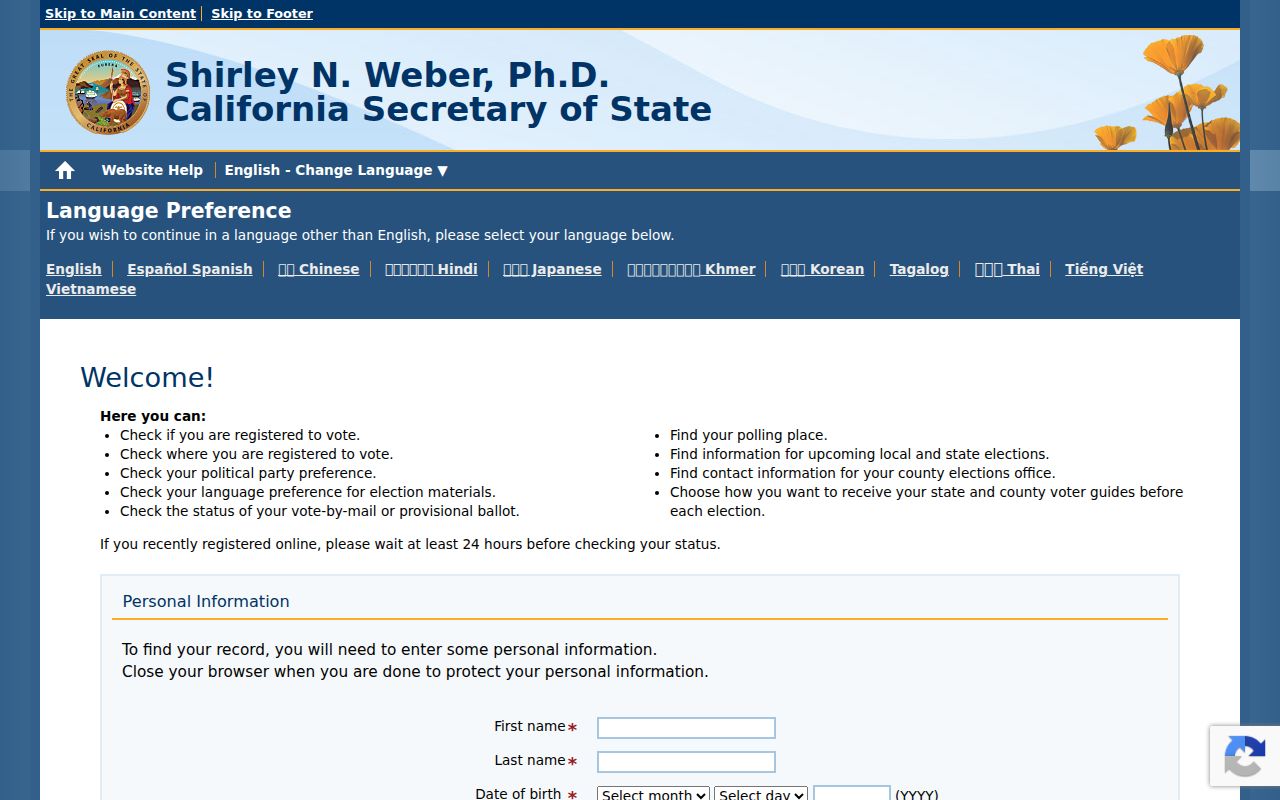
The form asks for a last name, birthdate, house number, ZIP Code, and a verification code. It checks the requester's own record only. Note: A directory source can describe ownership, registration, or affiliation without ever describing a complete household.
San Dimas Voter Records Limits
California voter registration information is purpose restricted. The private status form is a self-service check, nothing more. For election, scholarly, journalistic, political, or governmental purposes, a file request can be made. It falls under Elections Code sections 2188 and 2194. The application demands identity proof, a purpose narrative, and a security plan. It also requires the requested subset and a perjury signature. Fees are posted plainly: $100 for the statewide file, and $30 per specific record up to $100. Los Angeles County files carry separate charges. Authorized data can include a name, residence or mailing address, and phone or email. It can also include language, birth date, party, precinct, registration date, and participation history. Driver-license or ID data stays out. So do the last four Social Security digits and any signature image. Ballot choices never appear. Personal, commercial, and harassing use is prohibited outright. Safe at Home participants and other protected voters must never be reverse-located. April 2026's city report counted 23,826 registered voters in San Dimas. That figure offers civic scale, not a household index. The party totals are a report snapshot rather than a current identity directory.
San Dimas Business Records
Sometimes the clue is an organization rather than a person. It might be a profession or a local enterprise. In that case, reach for business and license records instead of treating an office address as a residence. California bizfile searches by entity name or number. Results can show status, jurisdiction, street and mailing addresses, agents, due dates, and recent filings. Los Angeles County fictitious business names add a county filing trail for local trade names. The California Department of Consumer Affairs searches professional licenses across its boards. San Dimas's HdL search accepts business type, address, or name. It suggests trying another category when a result comes back empty. These records can reconnect a former classmate or identify the organization behind a dated address. They can also mislead. A licensed premises, a registered agent, a mailing address, and a principal's address are four different fields. Read the record type and its date before attaching any person to a San Dimas parcel. The California Department of Consumer Affairs license search is the official page for verifying a professional's standing.
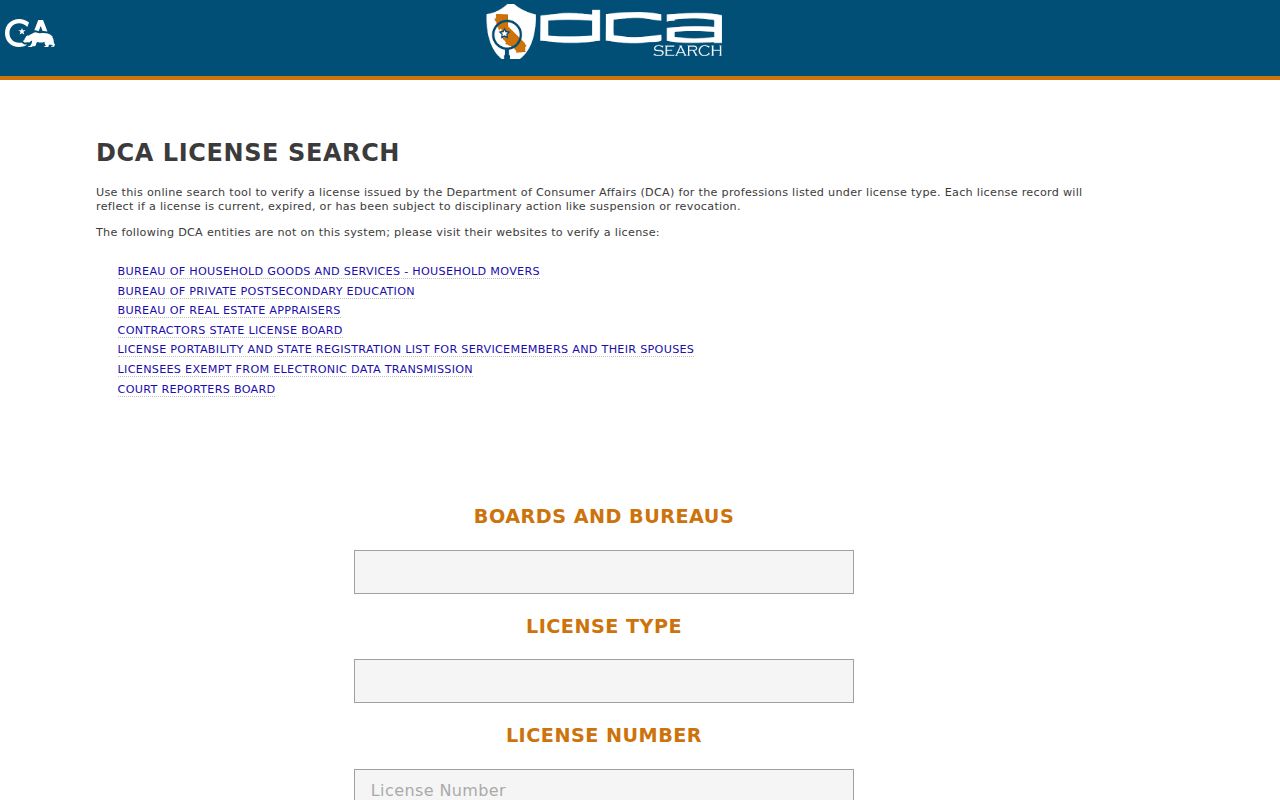
Its filters can narrow by board, license type, number, name, city, county, status, discipline, and documents where a board supports them. That granularity makes it easy to separate active licenses from lapsed ones.
Read the address field. Entity, agent, mailing, licensed-premises, and parcel addresses can all point to different places. None alone proves present residence.
San Dimas Vital Records
Birth, death, marriage, and dissolution certificates can pin down a date. They can also establish a place or a family tie. California opens them selectively. The state sets no blanket rule freeing every birth record after a century. It also frees no blanket rule for death records after fifty years. Health and Safety Code sections 103525 and 103526 split certificates into two types. An authorized copy establishes identity for an eligible applicant. An informational copy reaches more people but carries a mark stating it cannot establish identity.
Los Angeles County RR/CC runs the county birth, death, and marriage counters for San Dimas. The California Department of Public Health issues statewide certificates. It also holds the marriage and dissolution ranges it publishes. A mailed authorized birth request needs a notarized Certificate of Identity. The 2026 state fees run $31 for birth, $26 for death, $19 for marriage, and $18 for dissolution. County charges differ. Confidential marriages and adopted original birth records carry separate limits. The county's records services page is the first stop for birth, death, and marriage requests. A state application enters the picture after that. For court-side material, the Los Angeles Superior Court public access portal pairs with the case-access image shown here.
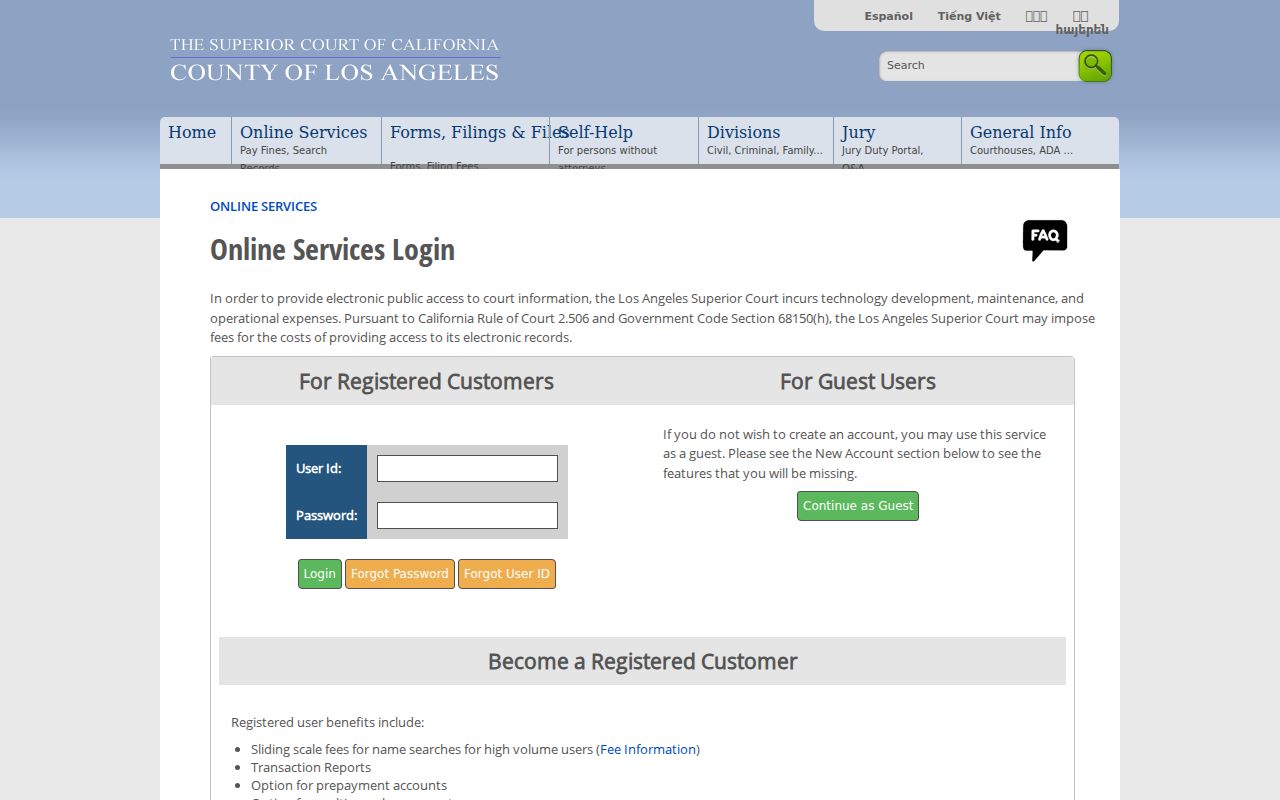
That court route reaches probate, family, and dissolution filings. A court index is not a vital certificate, though, and sealed matters stay out of view.
Historical San Dimas Resident Shelf
The historical San Dimas residents directory reaches back before the city incorporated. The San Dimas Historical Society's CatalogIt inventory charts the shelf: San Dimas directories from 1904 through 1926, Home Telephone volumes from 1904 through 1928, Associated Telephone volumes through 1946, a 1954 San Dimas Press Directory and Information Guide, and Luskey's 1959 Criss Cross City Directory. Later civic and business products fill out the shelf. Older regional material helps too. Pomona directories from 1895 to 1898 may list San Dimas residents from before incorporation. So may NARA microfilm for 1931 and 1934.
LA County Library's Californiana closed stacks hold census schedules, newspapers, nineteenth-century directories, and county histories. The San Dimas Library offers reference help and research services. The Society's Walker House catalog supplies the sharpest year-by-year trail. The San Dimas historical city directory collection page lays out the full method. For modern city records, turn to the City Clerk. The City Clerk records page is the office source displayed in the local-records image here.
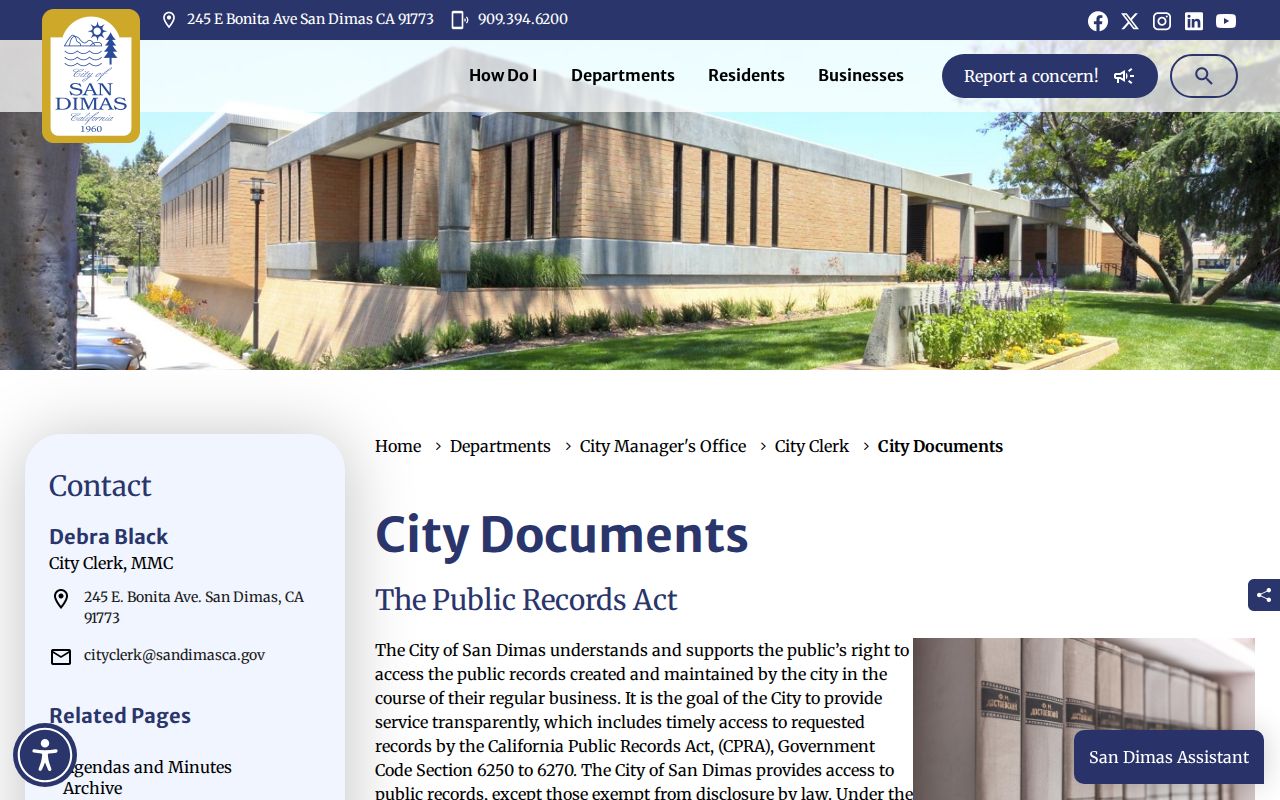
Council, board, commission, and Laserfiche material from the modern city rounds out the older library shelf.
Note: Library and Society catalog records identify a collection, so confirm interior-page access before citation.
San Dimas Directory Era
Place names around San Dimas shifted over time. The settlement began as Mud Springs. Town lots followed the Santa Fe railroad boom in 1887. They were laid out under the San Jose Ranch Company plat. Incorporation arrived August 4, 1960, after neighboring annexations. Someone living there before 1960 may appear under Los Angeles County, Pomona, Pomona Valley, Rancho San José, or Mud Springs. Some entries sit under unincorporated San Dimas. A missing San Dimas label proves nothing about whether the person or property was there.
The 1890 census loss makes city directories, deeds, newspapers, and clippings unusually precious. Historical Society folders hold named residents, obituaries, schools, churches, and clubs. They also cover veterans and businesses with page references. Treat the folders as a finding aid, not a digitized newspaper file. Search under the date-appropriate place name first. Then confirm the entry against a deed, census, court file, obituary, or another dated record.
San Dimas Resident Clippings
Some of the richest San Dimas resident leads are personal history trails. A former-classmate search can begin with the school era. It can then move through yearbooks, Bonita High or San Dimas High references, clipping folders, a later obituary, and public marriage, business, or license records. An heir trail starts with a probate petition or order plus an obituary. It then leans on a dated property, business, or license record for corroboration. These are human reasons to use the archive. They are not a license to assemble a broad name list.
The Historical Society catalog also describes lemon and orange association files, packing-house material, railroad records, Chamber holdings, churches, service clubs, and school topics. Those collections document affiliation and community presence. They do not prove a current address. Birth-family questions belong on the California adoption-information route or a court order. Sealed original birth records should never be bypassed.
Note: A clipping folder labeled with an obituary reference points to a page. It is not a certified death record.
San Dimas Public Records Requests
City Hall holds the material that never makes it into an online index. That includes permits, plans, code cases, correspondence, and council records. The city routes requests through NextRequest. The City Clerk also accepts email, and the Administration counter takes walk-ins. Inspection happens by appointment during normal business hours. Under the California Public Records Act, the city has ten calendar days to say whether it holds disclosable records. It can extend that by up to 14 days in writing for unusual circumstances. That clock only covers the determination. Production of the records can take longer. One more caution: anything entered into the request center is itself public information.
Permit research runs through Building and Safety. Its forms want an address. They also ask for the APN, the current owner's name and address, scope of work, contractor, and plans. Only the property owner, a licensed contractor, or an agent with notarized authorization dated within one year may pull a permit. A sharp request names the address, the AIN if known, the record type, and a date range. The statute behind all this is Government Code Division 10, sections 7920.000 and following. Inspection is generally free, but duplication and permitted extraction can carry costs. The county, courts, libraries, and state agencies each run their own request channels. Send yours to the actual custodian of the records.
San Dimas Resident Search Limits
A responsible San Dimas residents directory stops where the law stops. Safe at Home swaps a mailing address for qualifying protected participants. Voter files demand a qualifying purpose. Confidential marriage, adoption, juvenile, sealed court, DMV, and certain vital information stay restricted. California's DROP program can send a single deletion request to registered data brokers. It cannot erase lawful deeds or court records. It cannot force a custodian to break retention law.
Los Angeles County's jail information center, the CDCR locator, and the Megan's Law site each publish narrow use rules. They also publish warnings. A custody or registry result is not a full criminal history. It must never be used to harass anyone. Preserve the source URL and the date. Verify with the custodian. Stop when the next step would expose a protected address.
Note: Public records can be old or wrong. A record number and custodian confirmation matter more than a matching name.